Overview:
Students will use a pipe cleaner tree, hand held fan and tissue paper to demonstrate how wind disperses seeds. Students will be able to explain the benefits of seeds landing in the sun zone versus the zone of darkness (shade).
Time:
Assemble fan: 30 minutes
Pipe Cleaner Tree Assembly: 20-30minutes
Experiment: 40-60 minutes
Total Time: 1-2 hours
Lesson Materials:
*You can use the document in the link below to either: tailor the experiment to your needs or to have a printable version of this lesson plan*
Wind Dispersal of Seeds Experiment Lesson Plan
The plan is editable and printable. Copy the Google Doc in your own drive and make edits or you can just print.
Wind Dispersal of Seeds Experiment Lesson Video:
Learning Objectives:
- List the ways plant seeds are dispersed to new locations
- Demonstrate how seeds can move by formulating a model.
- Compare and contrast different seed structures and their ability to fly on the wind.
- Explain the benefits of seeds landing in the “sun zone.”
Materials Needed:
Tree Materials
- Pipe cleaners
- 15 Brown
- 15 Green
- 1 black construction paper
- 1 oz playdough
Seed Materials
Variety of materials to test out, such as:
- Cotton balls
- Construction paper
- Beads
- Bur or sticky type seeds
- Tape
- Paper
- Plastic bags
Wind Materials
- Motor
- Optional: motor holder
- Fan
- Battery holder for AA battery or snap wire connection for 9V battery
- 2 AA batteries or 1 9V for each fan
Demonstration Materials:
- Data Sheet
- Pencils
Experimental Methods:
Part 1: Building the Fan
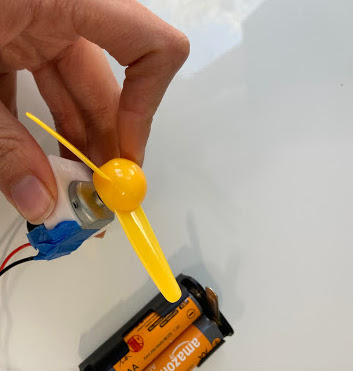
- Take the battery pack, motor, and holder from the box. Get 2 AA batteries.

- Place the motor in the white plastic holder, with the two small metal loops facing the top(where the opening of the holder is).
- Take the yellow fan top from the kit. Attach it onto the axle of the motor.

- To set up the circuit running the fan, take the red wire on the battery pack and fit the exposed wire(metal end) through the metal loop on one side.
- Carefully do the same for the black wire, but loop the exposed wire through the loop on the other side. Do not put the wires through the same loop!

- Place the tape over the wires to ensure they don’t slip out(the fan will stop working if they fall out).

- Place the batteries into the pack. Setup is complete!

Part 2: Pipe Cleaner Trees and Preparing the Seeds
Pipe Cleaner Tree:
Students can be creative and design their own trees. Show them images of plants that use wind pollination for inspiration. Here are instructions to make one type of tree:
- Take 6 pipe cleaners, laying them side by side.

- Take 2 pipe cleaners and twist them together about ¾ of their length. The untwisted part will act as branches for the tree.
- Repeat step 2 for the other two pairs of pipe cleaners.
- Twist the twisted pairs together so they make one tree.

Part 3, Day 3: Experiment
- Take a large piece of black construction paper and cut a circle 12 inches in diameter. Lay it down on a flat surface. This will be the “zone of darkness”.
- In the center of the circle, place a small ball of Play-Dough roughly the size of a golf ball. Place pipe cleaner tree in the Play-Dough. It will hold up the tree.

- Create a variety of “seeds” to test in the wind simulation
- Cotton balls – stretch and pull apart cotton balls to make them feathery
- Tissue paper – tear or cut into small pieces
- Pompoms
- Hypothesize which seeds will be best for wind dispersal.
- Attach the seeds on to the trees by balancing them within the branches. The picture below uses tissue paper.

- Place the fan in proximity to the tree and turn it on by pushing the metal bar at the end of the battery pack downward.
- Observe where the seeds land and record the number of seeds that go outside the “zone of darkness”.
- Repeat the experiment three times to observe any changes in data.
- Repeat steps 5-9 for the remaining seed types.
- Discuss the results.
Variations:
- To increase difficulty, cut a larger circle to expand the “Zone of Darkness”.
- Make it a competition! What shape can the students make their “seeds” to get as many as possible outside the “Zone of Darkness”?
Project was modified or adapted from [1] Mystery Science “How Did a Tree Travel?”
Expected Experimental Results:
At least some of the “seeds” should float outside of the zone of darkness outlined by the black construction paper. It is normal if not all of them make it outside the zone.
Questions to Think About:
- What shape makes the seeds fly the farthest?
- Can you make a shape that flies even farther?
- Some seeds are too heavy or the wrong shape to fly in the wind. List one or two examples to the kids(cherry seeds, avocado seeds). What are some other ways seeds could move to a good place to grow?
- Name the kinds of plants in your yard with seeds that travel in the wind.
- What would happen if seeds couldn’t be moved by the wind?
Chemistry:
Seeds need to move away from the shade of their parent plant and away from other seeds in order to access soil, sunlight and water. Without enough soil, water or sunlight the plants will not grow. Wind pushes the seeds away from the plants, and the shapes of the seeds help them glide or float farther away in a process called “seed dispersal.” If they land in a spot with enough soil, water, and sunlight, they can grow into a new plant. Wind is only one way that seeds can travel. Seeds can travel with the help of animals and water.
Society:
If seeds could not travel distances, new plants would not grow. Plants are important for people and animals, providing food, shelter, beauty, and oxygen to breathe. Forests would not exist without the help of wind to disperse seeds! Corn relies on wind for seed dispersal and it is one of the most important crops in the US. Plants are not unique in their use of wind to do work. Humans use wind to sail boats, fly kits and make electricity for people to use in their homes.
Logistics:
STEAM Subjects:
Ecology, Engineering
Science Vocabulary:
- Seed dispersal
- Wind
- Seed
- Shell
- Animals
- Battery
- Motor
- Assemble
- Circuit
- Fan (Propeller)
Supplementals:
Music
Seed Song – How Seeds Move – Seed Dispersal
Games/Interactive Websites
PBS Learning Media – Seed Racer | Plum Landing
Suggested Reading
The Tiny Seed by Eric Carle
Suggested Viewing
BBC Earth – Exploding Cucumbers! | Slo Mo #36 | Earth Unplugged
How Plant Seeds Travel the World
Additional Resources
Seed Dispersal – The Great Escape
References:
Forney, Julie Martins. “Cottonwood Tree Facts.” HGTV, https://www.hgtv.com/outdoors/flowers-and-plants/trees-and-shrubs/all-about-cottonwood-trees.
Kristina. “Pipe Cleaner and Beads Color Matching Tree.” School Time Snippets, https://www.schooltimesnippets.com/2013/10/pipe-cleaner-rainbow-tree-fine-motor.html.Mystery Science. “How did a tree travel halfway around the world?” Mystery Science, https://mysteryscience.com/plants/mystery-1/seed-dispersal/84?r=5169800.
Funding:
CSU Internal Funding Sources:
- IRA (Instructionally Related Activities Fund)
- Faculty Small Grant
External Funding Sources:
- Adobe

