Overview:
In this project students will learn the different parts of the water cycle in relation to weather. The students will be able to watch “rain” falling. This project should be done with an adult.
Time:
10-15 Minutes
Lesson Materials:
*You can use the document in the link below to either: tailor the experiment to your needs or to have a printable version of this lesson plan*
Make it Rain: The Water Cycle in Your Kitchen Lesson Plan
The plan is editable and printable. Copy the Google Doc in your own drive and make edits or you can just print.
Make it Rain: The Water Cycle in Your Kitchen Lesson Video:
Learning Objectives:
By the end of this experiment, students will be able to:
- Create a small scale water cycle.
- Understand the water cycle.
- Apply what they have learned to the weather.
- Evaluate why water has cycles and the way they work.
- Identify examples of the water cycle in everyday life.
Materials Needed:
- Pot to boil water
- Water
- Pie tin
- Ice
- Oven Mitts
Experimental Methods:
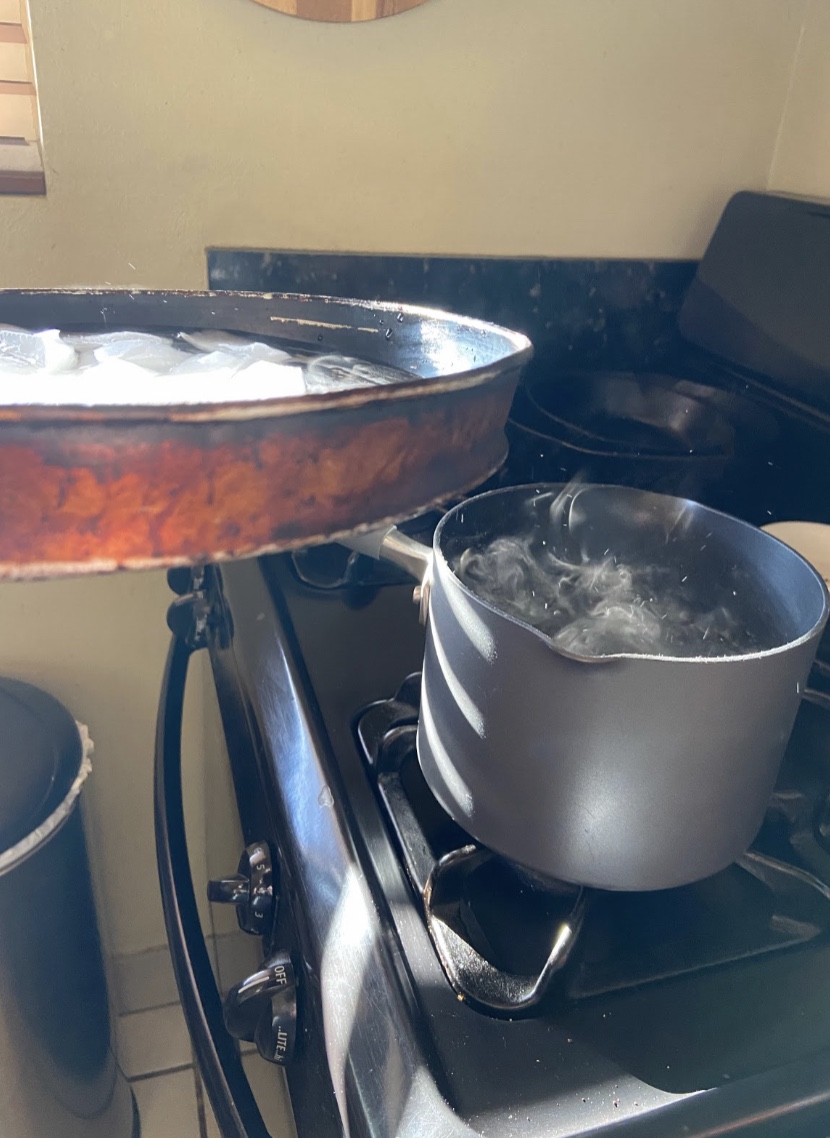
- Fill a pot with water and put it on the stove.
- When the water starts boiling get a pie tin.
- Put some cold water and ice cubes into the pie tin.
- Wearing oven mitts, hold the pie tin over the steam of the boiling water.
- After a couple of minutes there should be water vapor condensing on the bottom of the pie tin.
- If the drops become large enough they should begin to drop off the pie tin. This is the “rain.”
Project Was Modified or Adapted from reference #1
Project Extension Suggestions
- A pie tin can be used along with an ice tray or cake pan.
Expected Results:
If the experiment is done correctly, students will be able to see condensation form from the steam from the tea kettle. This condensation represents the Earth’s water cycle as water changes from a liquid to a gas, then back to liquid again.
Questions to Think About:
- If we used an ice tray instead of a pie tin do you think there would have been a different result?
- Why do you think the steam from the hot water made “rain”?
- How does this model act like the water cycle?
- After learning about the water cycle can you explain to me what the different parts are?
- Do you think you make the water drip at a faster rate? How?
Chemistry:
The water cycle has different parts that include: evaporating, condensing, and precipitating. Evaporation is when the water is taken from a liquid form and turned into a vapor. For example, water is taken from the ocean and made into water vapor in clouds. Condensation is when the water vapor is turned into a liquid. For example, when humid air touches the cold surface it makes drops. Precipitation is when the water falls from the clouds to the ground. For example, when it rains. This is the water cycle and it is happening constantly. In relation to our project we can see the different stages happening. The water in pie tin is water that has gotten turned into water vapor and the pie tin is the cloud. When the humidity from the boiling water hits the cold surface of the pie tin, or cloud, that causes precipitation and the rain to fall.
Society:
This project is related to society because it has to do with our environment. The water cycle is constantly happening and we need water in order to live. If the water cycle did not happen we would not have clean water for us to drink or use.
The water cycle Explained in a Video:
Logistics:
STEAM Subjects:
Science
Science Vocabulary:
Evaporation
Condensation
Precipitation
Water Vapor
Reference:
Science World. “Kitchen Water Cycle.” Science World, ASTC Science World Society 2020, 2020, https://www.scienceworld.ca/resource/kitchen-water-cycle/. Accessed 9 October 2020.
Funding:
CSU Internal Funding Sources:
- IRA (Instructionally Related Activities Fund)
- Faculty Small Grant
External Funding Sources:
- Adobe

