Overview:
Students will learn the importance of observing nature and how small details can have a major impact. Not only will this enforce STEM roots but the students will also learn the importance of protecting themselves from UV rays that they are exposed to everyday.
Time:
20-30 minutes
Budget:
Costs about $165 for about 100 people
Lesson Materials:
*You can use the document in the link below to either: tailor the experiment to your needs or to have a printable version of this lesson plan*
Sunscreen and Animal Adaptations Lesson Plan:
The plan is editable and printable. Copy the Google Doc in your own drive and make edits or you can just print.
Sunscreen and Animal Adaptations Lesson Video:
Learning Objectives:
- Create a way to process information from the world around them and make connections
- Evaluate a decision or hypothesis based on evidence
- Analyze situations so as to compare and contrast new information with previously known information
- Apply that thought process to real-world situations
- Understand and distinguish the reasoning behind why there is or perhaps is not a connection between their data
- Remember and recall the facts moving forward
Materials Needed:
- Black construction paper
- Ziplock bags
- Tubes of sunscreen
Experimental Methods:
Instructor Preparation
- Portion out dollops of sunscreen into ziplock bags (enough for each student to disperse enough sunscreen onto half of the construction paper using their hands)
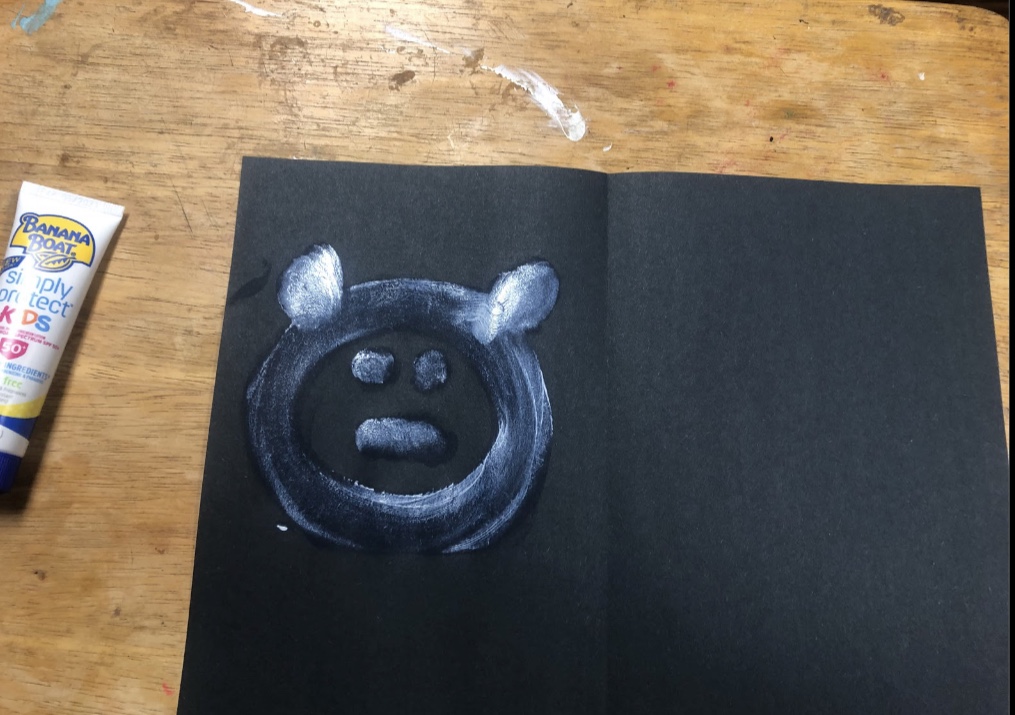
- Fold the black construction paper in half (hamburger style)
Experiment Steps (An open workspace is best to avoid accidental application of sunscreen on various surfaces)
- Open the black construction paper flat on one side with the crease visible down the center
- Open the ziplock bag containing the sunscreen
- Holding the ziplock bag open, remove enough sunscreen to cover 1 fingertip.
- With the dry hand hold the black construction paper open
- With the sunscreen coated finger draw yourself on one side of the folded line
- (optional) Reapply more sunscreen to the finger to complete the drawing.
- Once the drawing is complete rinse the excess sunscreen off with soap and water.
- After drying your hands, carefully carry the construction paper making sure not to mess up the picture (or get sunscreen on the other side of the crease)
- Place the paper flat in a sunny area and use small objects to make sure the paper doesn’t fly away
- Be sure to check the construction paper keeping it in the sun for about 5 hours.
- After the time has elapsed observe the difference from the sunscreen covered area and the empty side of the crease.
Project was modified or adapted from reference
- (Jenae)
Expected Experimental Results:
The area with the sunscreen drawing should be darker than the exposed area on the opposite side of the crease line. Thus, the paper experienced a fading of color due to exposure while the sunscreen coated area remained protected.
Questions to Think About:
- How can watching nature impact other aspects of your life?
- What other substances could you use for this project instead?
- What would happen if we used a different color paper?
- Why do you think that the color of the paper faded?
- What are other forms of protection from the sunlight?
Chemistry:
Have you ever spent all day and got a sunburn? Do you know what happens and why your skin was burned? Think about what happens when you stand outside in the sun. The first thing you feel is how warm the sun feels on your skin. What is touching your skin is called ultraviolet (UV) rays. UV rays are part of the sunlight that humans cannot see. UV rays can damage skin, cells and DNA. Our skin does not do a great job at protecting itself from getting too much sunlight, and that is when we experience sunburns. By applying sunscreen onto the paper and leaving it in the sun for several hours shows how much sunscreen protects the area it was applied to.
Society:
Children are meant to play and spend time outside. Whether it is sports or other activities, the sun is always going to come in contact with their exposed skin. Therefore, it is important to encourage the protection of their skin from UV rays at an early age as they will be spending most of their time outdoors for the next several years.
Logistics:
STEAM Subjects:
Science (Chemistry) and Art
Science Vocabulary:
Ultraviolet Rays, Sun Protection Factor
References:
- Jenae. “Why Do We Need Sunscreen?” Experiment icanteachmychild.com, ELITE CAFEMEDIA FAMILY & PARENTING, 13 June 2011, https://www.icanteachmychild.com/why-do-we-need-sunscreen-experiment/. Accessed 20 2 2021.
- Armstrong, P. (2010). Bloom’s Taxonomy. Vanderbilt University Center for Teaching. Retrieved [9/20/2021] from https://cft.vanderbilt.edu/guides-sub-pages/blooms-taxonomy/.
Funding:
CSU Internal Funding Sources:
- IRA (Instructionally Related Activities Fund)
- Faculty Small Grant
External Funding Sources:
- Adobe

